Wilton sits deep in it, close to everything.
A year here does not repeat itself.
Western Maine’s lakes and mountains country. Close enough to Portland for a weekend, far enough from everything else to forget what day it is. What people actually do here changes four times a year, and none of it requires leaving the county.
Ski days that start after breakfast
Titcomb Mountain in Farmington is close enough to be the everyday hill, with downhill, snowboarding and cross-country on the same afternoon. Saddleback and Sugarloaf are the big mountain days, and Sugarloaf’s Outdoor Center adds nordic skiing, snowshoeing and skating when nobody wants a lift ticket.
Sled trails run the region through the local club. And when the ice comes in, the fishing is a walk down your own lawn rather than a drive to a boat launch.
Sap, runoff and the lake coming back
Maine Maple Sunday opens sugarhouses across the state in late March, and there are producers within a short drive. Smalls Falls runs hard with snowmelt on the way up Route 4 toward Rangeley.
The Foothills Land Conservancy paths at the north end of the lake are birding at walking pace, herons and turtles and not much else. Mud season is what towns are for: the Fiddlehead Festival in Farmington, and a table by a window.
The lake is the plan
Paddle before the wind comes up, swim off the lawn, fish the first hour of light. Most days do not need more of a schedule than that.
When the group wants options, Kineowatha Park is 63 town acres on the same lake with a swimming beach, courts, picnic ground and two disc golf courses. Webb Lake and Tumbledown Pond are the day trip over in Weld. And the Wilton Blueberry Festival takes over downtown the first Friday and Saturday of August, which is the weekend everyone ends up planning around.
Take the long way home
Height of Land on Route 17 hands you Mooselookmeguntic and the whole western range from a pull-off, no summit required. Mount Blue is the real climb; Center Hill is the half-hour version with most of the view.
The Farmington Fair runs a full week in September, agricultural and entirely unironic. And this is hunting country: whitetail, black bear, grouse and woodcock, with an outfitter in Wilton itself if you would rather go out with a guide than figure it out alone.
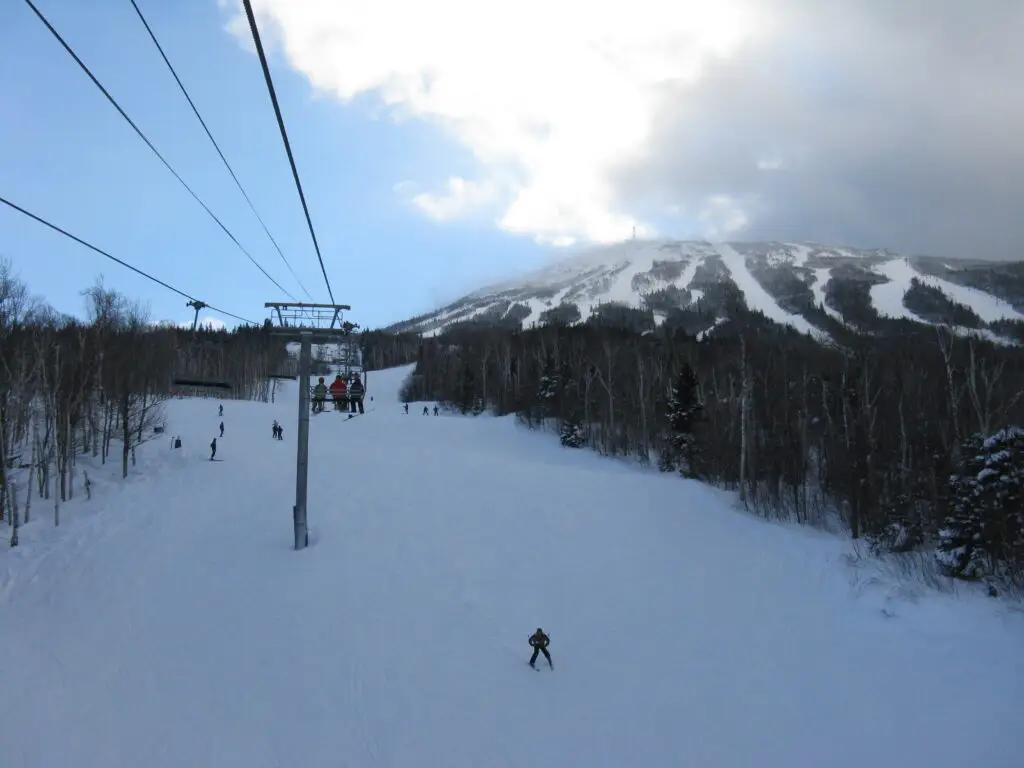
Sugarloaf, Carrabassett Valley. Under an hour and a quarter north, and the reason winter here is a season rather than a wait. Photo by Bubblecuffer, public domain via Wikimedia Commons.
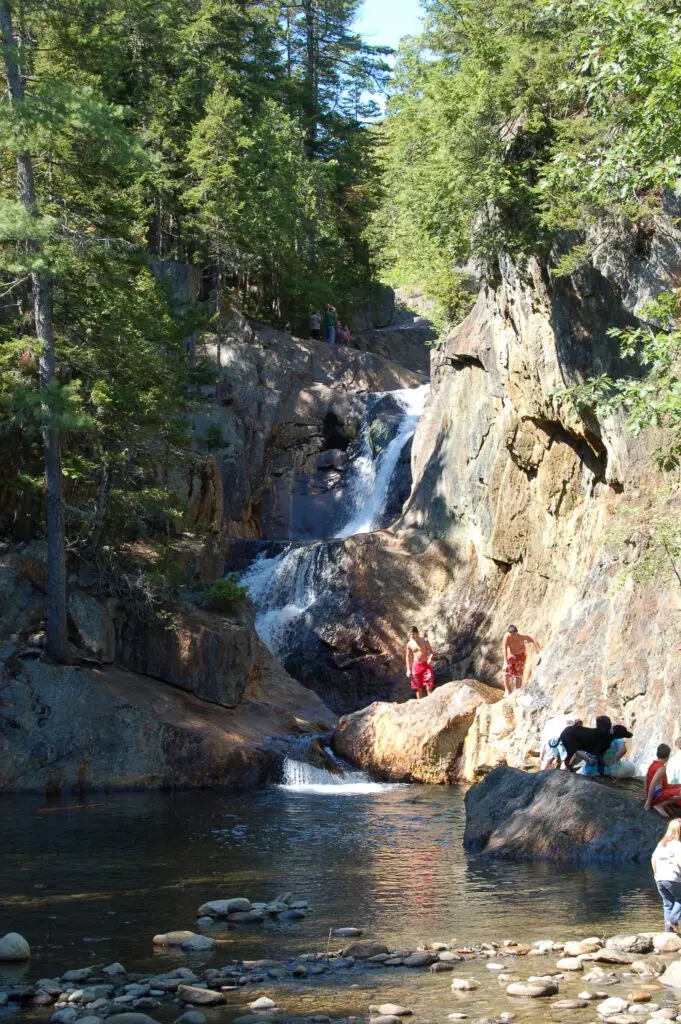
Smalls Falls, Route 4. A roadside stop on the way to Rangeley that runs hard every spring when the snow comes off the mountains. Photo by Tim Pierce, public domain via Wikimedia Commons.
Your first year here.
Two of these are already on the books for 2027. The rest come around the same way every year, which is rather the point.
Maine Maple Sunday
Always the fourth Sunday in March. Sugarhouses across the state open their doors, and there are producers within a short drive. The first thing all year that says winter is over.
Fiddlehead Festival
The university’s spring celebration of local food, music and the fiddlehead itself, ten minutes away in Farmington. The date moves with the season.
Wilton Blueberry Festival
Two days that take over downtown Wilton, the first Friday and Saturday of August, minutes from the end of the driveway. The weekend everybody ends up planning around.
Farmington Fair
A full week of agricultural fair, ten minutes up Route 4. Livestock, harness racing, pulling, midway, the whole thing. These dates are granted by the state, so you can plan around them.
Four day trips from the front door.
Rangeley and Height of Land
Route 4 north, Smalls Falls when the water is up, lunch on a deck in Rangeley, then Route 17 and the overlook on the way back through Rumford. The best full day in the region.
Weld and Webb Lake
Pick one: the beach at Webb Lake, the half-mile nature loop at Center Hill, or the climb up Mount Blue or Tumbledown. Mount Blue State Park covers all of it. Pack lunch, eat back in Wilton.
Carrabassett Valley
Sugarloaf in winter, or the golf, mountain biking and lift rides in summer. The Outdoor Center is the slower version of the same day, on skis or snowshoes instead of a chairlift.
Wilton and Farmington
The low-effort day. Kineowatha Park or the Foothills trails in the morning, lunch in Wilton, then downtown Farmington, the county seat, with UMF, shops and a proper dinner.
The particulars, for the people who ask first.
Anglers, hunters and skiers tend to want the specifics before they want the adjectives. Here they are, with the state’s own sources attached so you can check the work.
A cold, deep, wild-trout lake
Wilson Lake runs 563 acres and 88 feet deep, and it holds cold water all the way down: 70 degrees at the surface in summer, 45 at 85 feet. That is what makes it salmonid water rather than a warm bass pond.
The state’s own survey lists the principal fishery as salmon, lake trout, smallmouth bass and chain pickerel. The detail worth knowing: lake trout reproduce naturally here on the rocky shoals, and a small native salmon population is supplemented with periodic stocking. Brook trout get stocked occasionally on top of a wild population. Wild togue in your own front yard is not a common thing to be able to say.
- Also present rainbow smelt, white and yellow perch, landlocked alewife, hornpout, American eel, fallfish, golden shiner, white sucker, redbreast and pumpkinseed sunfish
- Open water and hard water both, with ice fishing a local habit rather than a novelty
- Public launch just south of downtown Wilton, if you want a second way onto the water
- Note the state files this water as Wilson Pond, Wilton, Franklin County. Check that entry, not the other Wilson Lakes in Maine
Wildlife Management District 13
Wilton sits inside WMD 13, the Western Mountain Foothills. Mixed hardwood and softwood, old farm edge, and a lot of it. This is a district people drive to, not one you have to leave.
If you would rather learn the ground with somebody than spend three seasons figuring it out, there is an outfitter in Wilton itself, on Morrison Hill Road, running guided trips. Ask them what they actually hunt and where before you book anything.
- Whitetail deer the main event, firearms and archery
- Black bear over bait, with hounds, or still hunting, depending on the season
- Ruffed grouse and woodcock the upland birds, and the reason to own a dog
- Moose by state lottery permit only, drawn by district
- Spring turkey a separate season worth planning a trip around
WMD 13 description ↗ · Moose permit lottery ↗
Seasons, bag limits, legal hours, licenses and landowner permission all change year to year. Check the current lawbook before you plan anything.
What comes past without being hunted
Four and a half acres on a point, with woods on the property lines and wetlands at the north end of the lake, is a lot of edge habitat. Edge is where things show up.
Friends of Wilson Lake photograph great blue herons and ducks on this water regularly, and the Foothills Land Conservancy paths run out toward the marshy north end where the water birds and turtles are. Deer move through field edges at either end of the day. The same district that supports a bear season supports bears you will occasionally just see.
Bring binoculars and expect to use them from the porch as often as from a trail.
Three mountains and a trail network
Most Maine lake houses are a long way from a lift. This one has three options, at three different commitment levels, and none of them is a road trip.
- Titcomb Mountain, Farmington. The after-lunch hill. Downhill, snowboarding and cross-country, with rentals for all three on site
- Saddleback, Rangeley. A full mountain day with dinner in town on the way home
- Sugarloaf, Carrabassett Valley. The big one. Its Outdoor Center is the quieter version: nordic, snowshoe, skating and fat bike
- Snowmobile trails run the region through the local club. Arrange access, registration and equipment before you ride, and do not assume the property connects to an open trail
- Mount Blue State Park for snowshoeing and winter walking when nobody wants a lift ticket
Closer than it feels.
- Portland, ME72 mi · about 1 hr 30
- Boston, MA174 mi · about 3 hr 30
- Portland Jetport (PWM)72 mi
- Bangor Intl (BGR)84 mi · about 1 hr 50
- Farmington10 min
- Sugarloaf / SaddlebackUnder 1 hr 15
Both airports run daily commercial service to Boston, New York and connecting hubs.
Nobody cooks every night.
- Calzolaio Pasta Co. · Wilton
Pasta, brick-oven pizza and Maine seafood on Main Street. The sit-down dinner in town, and they take reservations. - The Square · Wilton
Pub food and craft cocktails, two doors down at 280 Main. - The Homestead Kitchen and Bar · Farmington
Downtown on Broadway. Scratch cooking, a menu that moves with the season, live music. Worth the ten minutes. - The Farmhouse Beer Garden · Farmington
A renovated barn on Farmington Falls Road. Maine beer and cider, pizza, and a yard to eat it in. - Parkside & Main · Rangeley
A deck over the lake beside the town park. The lunch stop on the Height of Land day.
Hours and menus change with the season. Check before you drive.